Why Inclusive Sports Matter for Children with Intellectual Disabilities
Why Inclusive Sports Matter for Children with Intellectual Disabilities
By Roshelle Brago Boakye Foundation (ROBBFOUNDATION)
Sport is often described as a game, a form of exercise, or a way to develop talent. But for children with intellectual disabilities, sport can mean much more.
It can be a pathway to friendship, confidence, independence, belonging and opportunity.
For many children with intellectual disabilities, opportunities to participate in organized sports remain limited. Some are excluded because of misconceptions about their abilities. Others lack access to inclusive sporting programmes, trained coaches, appropriate facilities or community support.
This needs to change.
Every Child Deserves the Opportunity to Play
Children with intellectual disabilities have the same desire to play, compete, make friends and experience the joy of achievement as any other child.
Yet, too often, disability becomes a reason for exclusion.
A child may be told that a particular sport is “not for them.” A family may hesitate to register their child because they fear discrimination. Sports clubs may not know how to adapt activities to accommodate different abilities.
These barriers can prevent children from discovering talents they never knew they had.
Inclusive sports challenges these assumptions.
It starts with a simple belief:
Every child has abilities. Every child deserves an opportunity to participate.
Sport Builds More Than Physical Fitness
Participation in sports can help children develop physical coordination, balance, strength and endurance.
But the benefits go beyond physical health.
Through sport, children can learn to:
* Follow instructions and routines
* Work with others
* Communicate
* Take turns
* Develop discipline
* Handle winning and losing
* Build confidence
* Develop independence
* Make friendships
* Set and achieve goals
For a child who may experience exclusion in other areas of life, successfully completing a sporting activity can create a powerful sense of achievement.
A simple moment—a child hitting a table tennis ball, completing a badminton rally, scoring a point or crossing a finish line—can become a moment of transformation.
Sport Creates Belonging
One of the greatest challenges faced by children with intellectual disabilities is social exclusion.
Sport creates an opportunity to change this.
When children train and play together, they begin to see each other beyond disability. They become teammates, friends and competitors.
Parents also benefit.
They have an opportunity to connect with other families, share experiences and build support networks.
Communities benefit too because sport creates spaces where disability becomes visible—not as a limitation, but as part of the diversity of the community.
From Inclusion to Leadership
Inclusive sports should not only be about allowing children with disabilities to participate.
We should also create opportunities for them to develop their talents and leadership potential.
A child who begins as a participant can eventually become an athlete, team captain, coach assistant, mentor or advocate.
This is why community-based sports programmes are important.
Children should not have to wait until they reach elite levels before their abilities are recognized. Talent development can begin in the community.
Building Inclusive Sports in Ghana
Ghana has enormous potential to use sport as a tool for social inclusion.
But inclusive sports need intentional investment.
Communities need accessible sporting programmes. Coaches need training on how to work with children with different abilities. Parents need information and encouragement. Schools, sports organizations, disability organizations, local authorities and private-sector partners need to work together.
Most importantly, persons with disabilities should be involved in designing programmes that affect them.
At ROBBFOUNDATION, we believe that inclusion must move beyond conversations and awareness campaigns.
It must happen in everyday community life.
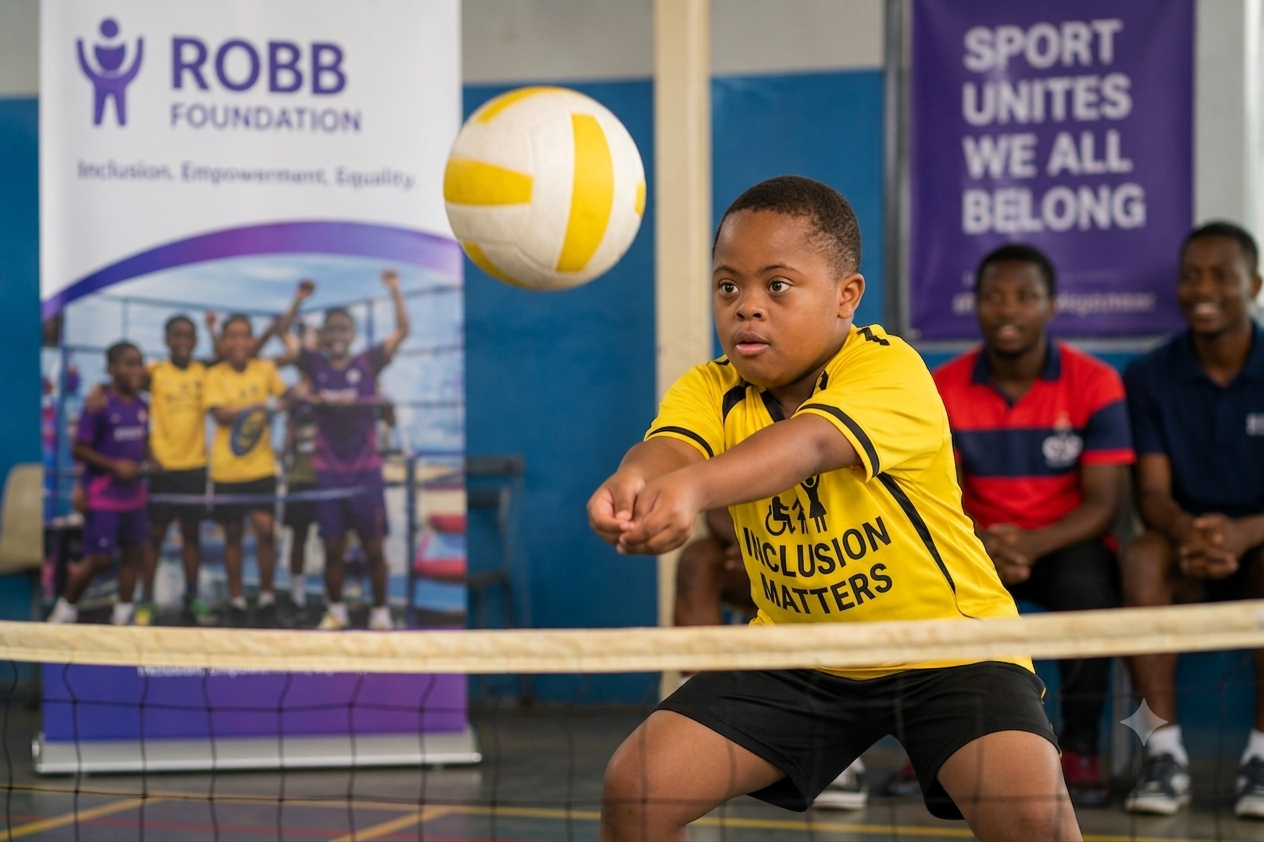
That is why we are developing community-based sporting opportunities for children and young people with developmental and intellectual disabilities, including activities such as table tennis, badminton, volleyball and other inclusive sporting activities.
Our goal is not simply to create athletes.
Our goal is to create opportunities for children to discover their abilities, develop confidence, build friendships and know that they belong.
What Can We Do?
Inclusive sports require collective action.
Parents can encourage their children to participate and celebrate effort rather than only results.
Coaches can learn how to adapt training and communicate effectively with athletes with different abilities.
Schools and communities can create safe and welcoming spaces for participation.
Businesses and donors can invest in equipment, coaching, facilities, transportation and athlete development.
Government and policymakers can strengthen inclusive sports policies and ensure that persons with disabilities are included in community and national sporting programmes.
And society as a whole can challenge the attitudes that tell children with disabilities what they cannot do.
The Child Behind the Disability
Perhaps the most important thing we need to remember is that a child with an intellectual disability is first and foremost a child.
A child who wants to play.
A child who wants friends.
A child who wants to be celebrated.
A child who wants to achieve something and hear someone say:
“You did it!”
We should not allow disability to become a barrier between children and these experiences.
Inclusive sports give us an opportunity to build communities where every child is seen, valued and given the chance to participate.
Because inclusion is not simply about opening the door.
It is about making sure everyone is welcomed inside.
Join the Movement
ROBBFOUNDATION is committed to creating community-based opportunities for children and young people with developmental and intellectual disabilities to participate in sports, develop their abilities and build inclusive communities.
We invite parents, athletes, coaches, volunteers, sports organizations, schools, businesses and development partners to join us in making inclusive sports a reality.
Together, we can move from exclusion to participation, from participation to empowerment, and from empowerment to opportunity.
Roshelle Brago Boakye Foundation (ROBBFOUNDATION)
Advancing Disability Rights. Building Inclusive Communities.
🌐 www.robbfoundation.org